

The value of history
Tuesday 25 December 2001
After Christmas lunch I read a few chapters of Fred Smeijers’ Counterpunch (which I mentioned a few days back). I was taken with the way he answered the question ‘what is the value of history’:
A book like this one finds its place at a higher level: at the level of the question ‘what is the value of history?’ But that apparently abstract question also belongs to daily necessity. Because without such knowledge you float, without direction. History is there anyway, and it helps to know about it. In the long haul of human history, as in the short haul of our individual lives, discovering or remembering what happened in the early days can be essential for life in the present. This isn’t to say that there is a ready-made history there to be discovered. History changes constantly. New discoveries, new perspectives constantly change the shape of what is known. Facts, data, and the knowledge of them, is not what I mean by history. Rather, history is more like a puzzle that we try to complete, but which will always be unfinished. We look for patterns that make sense.
But why? What for? To let you—you the reader—compare now with then. In the colleges and universities, history is sometimes just the material of academic careers. But history is a human right and should be open to everyone. It is the way in which we represent ourselves, think and feel about ourselves, in which we create our cultures. History is not primarily a story about ‘where we come from’, about heritage or ancestry. It is more immediate than that. What history can do is help us to feel connected with the things that we do and are interested in. Forget the school history of great men and great events. For every imaginable subject or activity there is a history to be constructed. Do not believe that it need only be about high culture in the arts and sciences. Do not accept that it is limited by what can be read on paper in archives. It needs much less paperwork than the professional historians like to admit. It is quite possible that a young rock guitarist, reflecting on his own way of solving musical problems, can say much more interesting things about Paganini than a biographer who knows all the facts of the great musician’s life. History needs to become much more active, and so it needs to abandon its academic inhibitions. True history has no rules, no fixed angles or methods.
The history of typography is hard to get hold of, incomplete, unclear, wrong, just too old, or perhaps not old enough. You have to work for it. Maybe this book can help here. At least now it is clear to me that sitting and looking at punches is not enough. If you want to understand these things, then you have to make some yourself. I recommend to the theoreticians that they have a go at making some of these things of which they speak so knowledgeably.
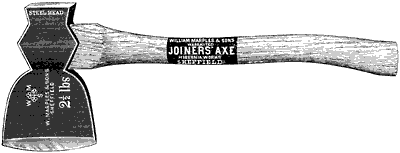
Point taken. I guess I should sharpen my broad axe and pitsaw, and do some hewing and sawing before I theorise any more about how slab buildings were made.