Marking time
Ten more digital years
Ten years ago I listed the ten digital cameras I had owned since I bought the first one in 2002. This post brings the story up to date. In the last ten years I have bought another five cameras, of which two were new and the rest second-hand.

 1 This is me, and my partner Margie, celebrating my birthday in 2017. Our daughter Sally picked up my FujiFilm X-E1 with 18mm f2 lens and shot this picture. I had bought this camera second-hand, to experiment with carrying an aps-c mirrorless camera as a lighter and more compact alternative to my full-frame Canon EOS system. I liked the Fuji, with its crisp sensor and lenses and its direct controls for aperture and shutter. I took it on a trip to South Africa, Botswana, Zimbabwe, Italy, Austria, Germany and Scotland (along with a Canon 5D mark II) and used both systems.

 2 Later in 2017 I replaced my old iPhone 4 with a second-hand iPhone SE. The old phone couldn’t run the Scrivener and Macquarie Dictionary apps, which prompted the upgrade. I admit that its camera makes a fine note taker, in the right circumstances, such as recording this diagram I saw in a market in Trieste.

 3 In 2019, after enjoying the FujiFilm X-E1, I decided to buy a new X-E3 body as the basis for a lightweight compact travelling kit. For a trip to France and the Netherlands I intended to take just the X-E3 and a couple of small lenses. Then came Covid, and the trip was off. I took this shot at a Black Lives Matter gathering in Brisbane in June 2020.

 4 My next purchase was a Canon 6D Mark II body—a full-frame DSLR with a swivelling LCD, inbuilt GPS, inbuilt level, all important conveniences for photographing historic buildings and sites. My old 5D Mark II became a backup, and the original 5D was stored away. Here is a photograph of a calf sale yard at Warwick, Queensland.

2 Late in 2021 I had a replacement battery fitted to my iPhone SE. The new battery failed and damaged the phone. I still liked the small, pocketable form of the iPhone SE, so I bought a second-hand Second Generation model. It’s a handy snapshot camera for shots like this one of the Point Lookout Lighthouse.

Frank Hurley starts out
The adventurous photographer and cinematographer Frank Hurley—who went to Antarctica with Mawson (1911–1914) and Shackleton (1914–1916), then to Palestine and Flanders with the AIF in the Great War, and to the wilds of Papua in the 1920s—started his photography career in the postcard trade.
I am pleased to have acquired an example of Hurley’s early work, which shows a structure I am very familiar with—the lighthouse at Nobby’s Head. This lighthouse, which was first lit in 1858, was one of the 58 historic lighthouses I surveyed in 2006–2007.


Paul Costigan has published some notes about Hurley’s early postcards, with examples. His examples include a distant view of Nobby’s Head, with the lighthouse visible.
Vaccination
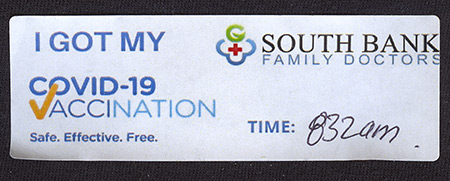
Diary note: This morning I received my first dose of AstraZeneca Covid-19 vaccine. I walked out of the clinic with this new label on my shirt.
Footpath ephemera
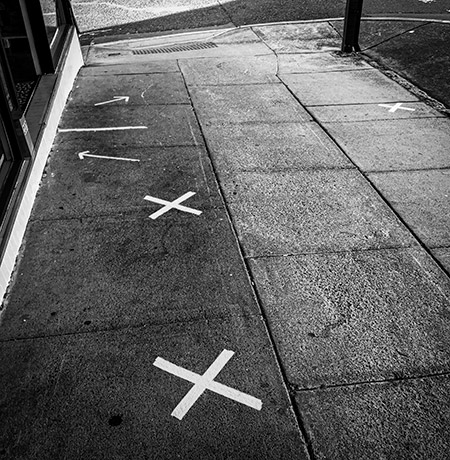
I took a photo of some arrows and crosses marked with tape on a footpath outside a local cafe—a snapshot of the choreography of social distancing in these COVID-19 times. In the future, perhaps, a photo of these marks will be a curiosity, a puzzle.
Seeing these marks on the ground reminded me of something from my childhood. In mid-1957, as an eight-year-old, I transferred to Kenmore State School. It was a one-teacher school then, where all the pupils, about 40 of us ranging from Grade One to Grade Six, sat in the same room at six-seater desks. Each morning we assembled in rows outside the classroom, in the same arrangement as our desks inside. A grid of wooden pegs driven into the ground, and barely protruding above the grass, marked exactly where each of us was to stand.
As we stood to attention on our marks, the teacher made announcements and exhortations from the verandah. Then, row by row, we marched up the stairs, across the verandah, and into our places in the classroom to the strains of the Colonel Bogey March played on a gramophone.